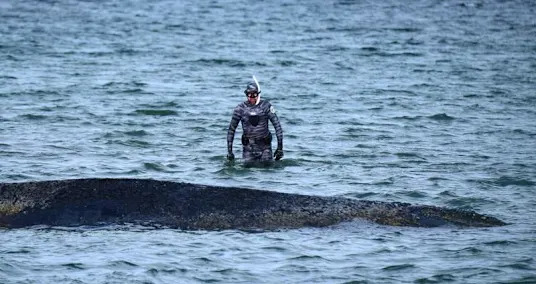
Rescuers on Thursday again attempted and failed to free a humpback whale stranded on Germany's Baltic Sea coast, employing a large suction dredger to remove sand around the animal.
Two excavators dug a trench in an attempt to free the whale, which has been stuck in shallow waters at the Timmendorfer Strand beach since early on Monday, drawing heavy media attention.
The aim of the latest rescue attempt was to approach the 12- to 15-metre-long marine mammal slowly, partly so that it can get used to the sounds, said Sven Partheil-Böhnke, the mayor of Timmendorfer Strand.
The work requires full concentration as rescuers are expected to reach within a centimetre of the animal's head, explained the mayor.
Excavator operator Tim Löhndorf told dpa on Wednesday that the plan was to dig a trench 50 metres long, six metres wide and 1.20 metres deep in front of the whale's head.
Wind and currents would pose particular challenges during the rescue operation, he said.
Before the rescue attempt began, biologist Robert Marc Lehmann approached the stranded animal, which reacted with movement and loud snorting.
The diver's assessment showed that the animal appeared to be in relatively good condition, said Stephanie Gross from the Institute for Terrestrial and Aquatic Wildlife Research (ITAW), adding that the whale seemed motivated.
Efforts to free the huge seaborne mammal continued into the night but were ultimately called off late on Thursday and are set to resume on Friday. By Thursday evening, however, the animal had at least managed to shift its position slightly, a dpa reporter said.
Even if the whale can be successfully freed, it will not yet be out of the woods. As the Baltic Sea is not its natural habitat, it must find its way back to the North Sea and then on to the Atlantic without becoming stranded again.
The Baltic Sea presents a bottleneck, said Jan Herrmann, a vet and whale expert from Wilhelmshaven.
"It has to find the way out again, and it is not entirely certain that the humpback whales' navigation system is designed for that," Herrmann said.
ITAW expert Joseph Schnitzler said the whale would certainly need to be escorted to find its way out.
"And then we'll just have to hope that the animal makes the right decisions, because you can't really guide it," he added.
The humpback whale was discovered on the sandbank on Monday morning. On Tuesday, a rescue attempt with a small suction dredger failed.
Attempts to make waves using police boats to allow the whale to swim free also proved unsuccessful. Even the high tide on Tuesday night was not enough to free the trapped sea mammal.
According to experts, humpback whales can weigh up to around 30 tons and have a life expectancy of up to 90 years. The species is characterized by its long pectoral fins, which reach a third of its body length.

latest_posts
- 1
 How we came to be: Scientists get first look at the evolution of early complex animals
 - 2Flu season is ramping up, and some experts are "pretty worried"
- 3An ex-FBI agent analyzes what we learned from Savannah Guthrie's 'Today' show interview amid the search for her mother Nancy
- 4With Obamacare premium hikes, more people opting for no coverage or cheaper plans
- 5Astronauts beam home Christmas wishes from International Space Station: 'I think we may be orbiting a little higher than Santa' (video)




- New York to require social media platforms to display mental health warnings
- Dental, Vision, and Hearing Inclusion in Senior Protection.
- The Craft of Do-It-Yourself Home Stylistic layout: Change Your Space
- Geminid meteor shower 2025 peaks next week. Here's what you need to know about this year's best meteor shower
- Wolf bites woman in a shopping area in Germany's 2nd-biggest city
- FDA proposes use of sunscreen ingredient popular in other countries
- Instructions to Utilize Your Brain science Certification to Work on Corporate Culture
- Study casts doubt on potential for life on Jupiter's moon Europa
- Iranian-linked drone attack kills Kurdish couple in northern Iraq